
What Does "Physio-Informed Pilates" Actually Mean?
Aug 31, 2026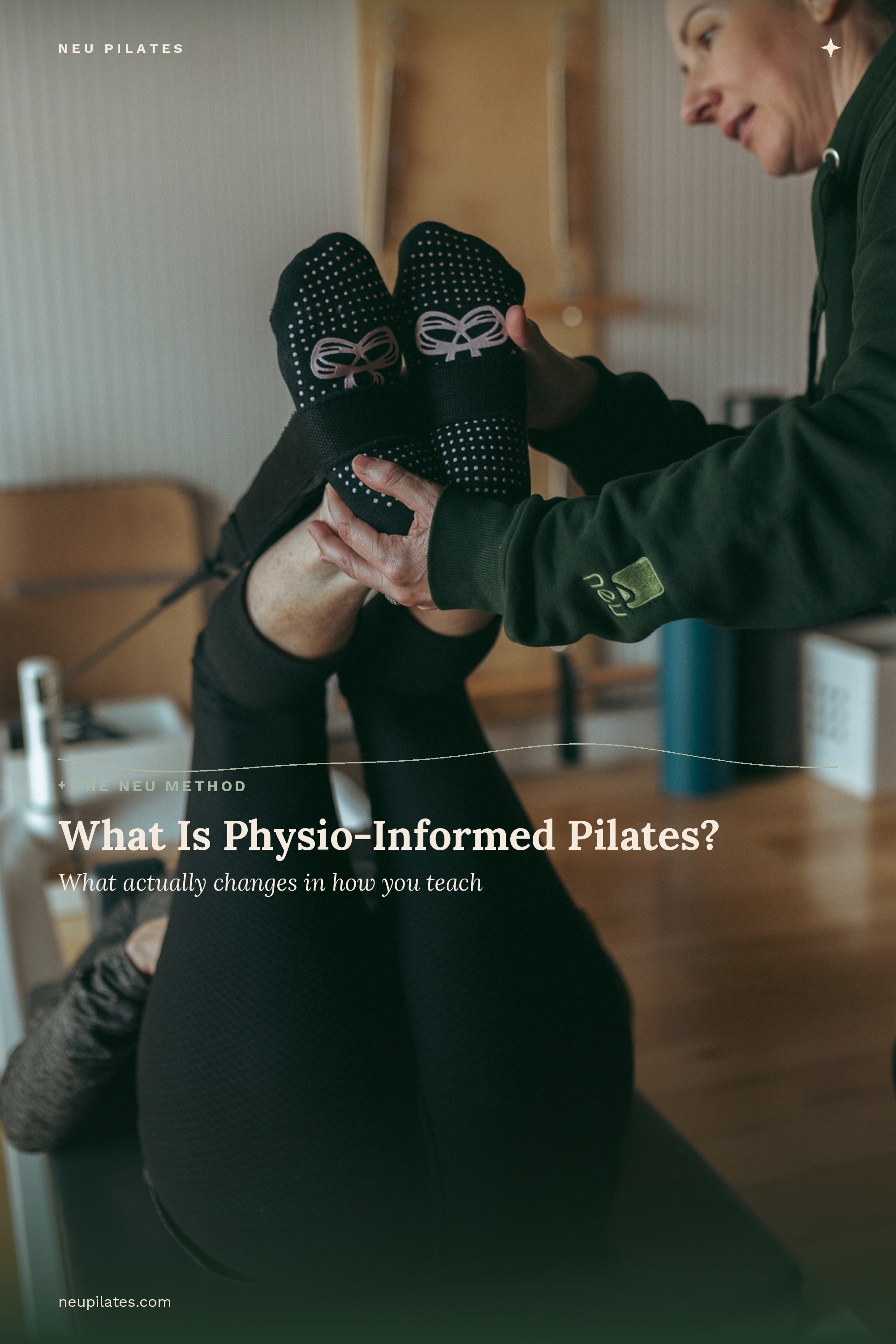
Physio-informed Pilates means the exercise selection, cueing, and modifications are built on physiotherapy reasoning — understanding why a movement affects a specific joint, muscle group, or injury pattern the way it does — rather than teaching a fixed sequence and adjusting only when something visibly goes wrong.
It's a term that gets used a lot right now, often as a marketing label without much behind it. Here's what it actually changes, and just as important, what it doesn't claim to be.
What It Doesn't Mean
Physio-informed Pilates is not physical therapy, and a Pilates instructor trained this way is not a substitute for one. It doesn't diagnose conditions, treat injuries, or promise to fix a herniation or straighten a scoliosis. That's outside the scope of Pilates instruction, physio-informed or not.
What it means instead: an instructor who understands enough physiotherapy reasoning to teach around a diagnosis safely — recognizing patterns, choosing appropriate modifications, and knowing when to refer someone back to their physiotherapist or doctor rather than push through.
What Actually Changes in How You Teach
Assessment. Instead of just watching for form, you're watching for compensation patterns — is someone using their lower back to avoid loading a weak hip? Is a "tight hamstring" actually a symptom of something upstream?
Exercise selection. Rather than teaching a fixed sequence, you learn to select and adapt exercises based on what a specific body needs — different entry points for someone with a disc injury than for someone with hypermobility, even in the same class.
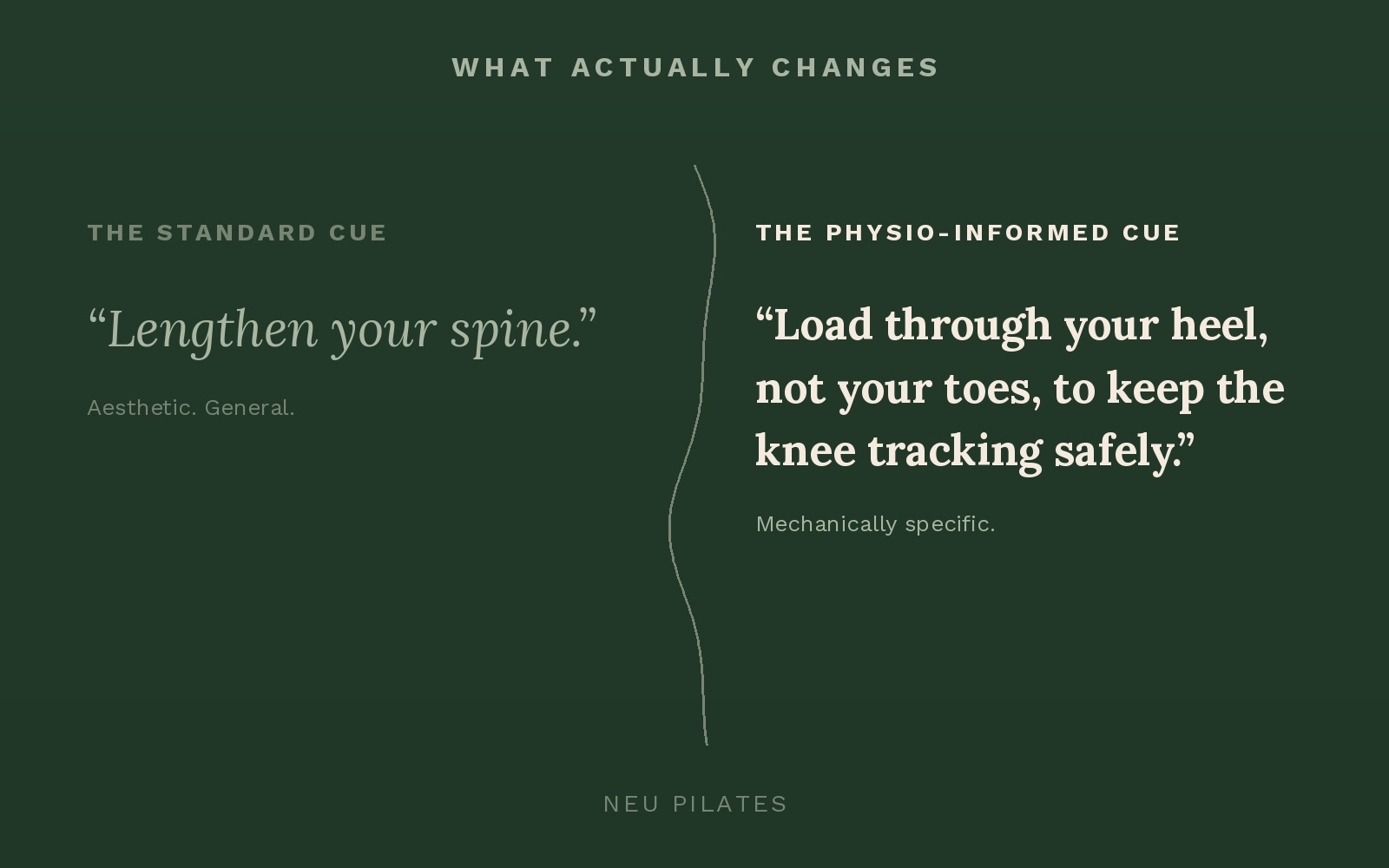
Cueing. Cues shift from purely aesthetic ("lengthen your spine") to mechanically specific ("load through your heel, not your toes, to keep the knee tracking safely") — because you understand the joint mechanics behind the instruction, not just the visual.
Judgment calls. You know when an exercise needs to be modified, when it needs to be skipped, and when someone needs to see a physiotherapist before you'd continue working with them at all.
Why This Integration Actually Holds Up
This isn't just a philosophy — there's a real and growing body of research behind Pilates as a legitimate rehabilitation and pain-management tool. A few examples:
- A 2023 meta-analysis of 19 randomized controlled trials (1,108 patients) found Pilates significantly reduces pain and functional disability in chronic low back pain, largely through training deep core stabilizers.
- A 2024 systematic review in Sports Health mapped optimal dosing parameters for Pilates in musculoskeletal rehabilitation — how much, how often, and for how long tends to produce results.
- A 2024 review in BMC Sports Science, Medicine and Rehabilitation found Pilates effective for spinal deformity and posture correction, including scoliosis.
- A 2023 randomized controlled trial found Pilates-based exercise significantly reduced pregnancy-related low back and pelvic pain.
None of this makes Pilates a replacement for physiotherapy. It's evidence that Pilates, taught with clinical reasoning behind it, is a legitimate tool for the populations instructors are most afraid of getting wrong — chronic pain, postpartum, and injury recovery.
What This Looks Like at Neu Pilates
Every Neu Pilates course is co-taught by a physiotherapist (Jen Gulley, FCAMPT) and a Pilates instructor (Lara Yanik) — not in separate modules, but together, so the movement instruction and the clinical reasoning behind it are taught as one thing rather than bolted together. That's the difference between memorizing that an exercise is "good for the low back" and understanding why, so you can adapt it the moment a real client doesn't match the textbook.
[Explore Neu Pilates Certification →]
Frequently Asked Questions
Is physio-informed Pilates the same as clinical Pilates? They overlap. "Clinical Pilates" is often used when a physiotherapist delivers Pilates directly as treatment. "Physio-informed" typically describes Pilates instruction shaped by physiotherapy reasoning, taught by an instructor — which is the model Neu Pilates teaches.
Can a physio-informed Pilates instructor treat my injury? No. Instructors trained this way can teach and modify safely around a known injury or diagnosis, but diagnosis and treatment remain within a physiotherapist's or doctor's scope.
Is "physio-informed" just a marketing term? It can be, if there's nothing behind it. Ask any program using the term to explain specifically how physiotherapy is integrated into the curriculum — co-taught modules, named clinical credentials, and concrete examples are the difference between substance and a buzzword. (This is one of the questions worth asking on any discovery call before enrolling.)
Do I need a physiotherapy background to learn this way of teaching? No. Neu Pilates teaches the physiological reasoning alongside the technique, so instructors without a clinical background still learn to think this way.
Start your journey to becoming a Pilates teacher today.
Stay connected with news and updates!
Join our mailing list to receive the latest news and updates from our team.
Don't worry, your information will not be shared.
We hate SPAM. We will never sell your information, for any reason.
