
What Is Fascia? Why It's the Missing Link in How You Teach Pilates
Aug 26, 2026
Fascia is the layered tissue that wraps around every structure in your body — muscles, organs, bones, blood vessels, and nerves. It's not just packaging. Research increasingly treats it as a sensory organ in its own right, one that communicates with your nervous system as much as it holds you together.
The Nervous System Connection
Fascia is threaded with free nerve endings and mechanoreceptors — research suggests fascia carries six to ten times more mechanoreceptors than muscle tissue does, feeding your central nervous system constant information about where you are in space and how safe your body feels. That density is also why interoceptive disorders — including anxiety and depression — are increasingly studied through a fascial lens by researchers like Robert Schleip.
This is what we mean when we say fascia is the bridge between your body and your nervous system.
What Happens When Fascia Gets "Stuck"
Fascia can become restricted from injury, disuse, or chronic stress. Restricted fascia tends to feel dehydrated, sticky, and rigid — and it can reinforce the exact compensation pattern a client came to you to resolve. (There's also a deeper connection between fascia and stored emotional stress — enough research there for its own post, coming soon.)
This is why cueing a "perfect" exercise sometimes doesn't work. If the fascia underneath isn't communicating clearly with the nervous system, the activation pattern you're asking for may not be available to that body yet.
What We Found Testing This in Our Own Studios
The working number in Pilates and rehab circles has long been that it takes roughly 17,000 repetitions to rewire a movement pattern — about six months of consistent practice.
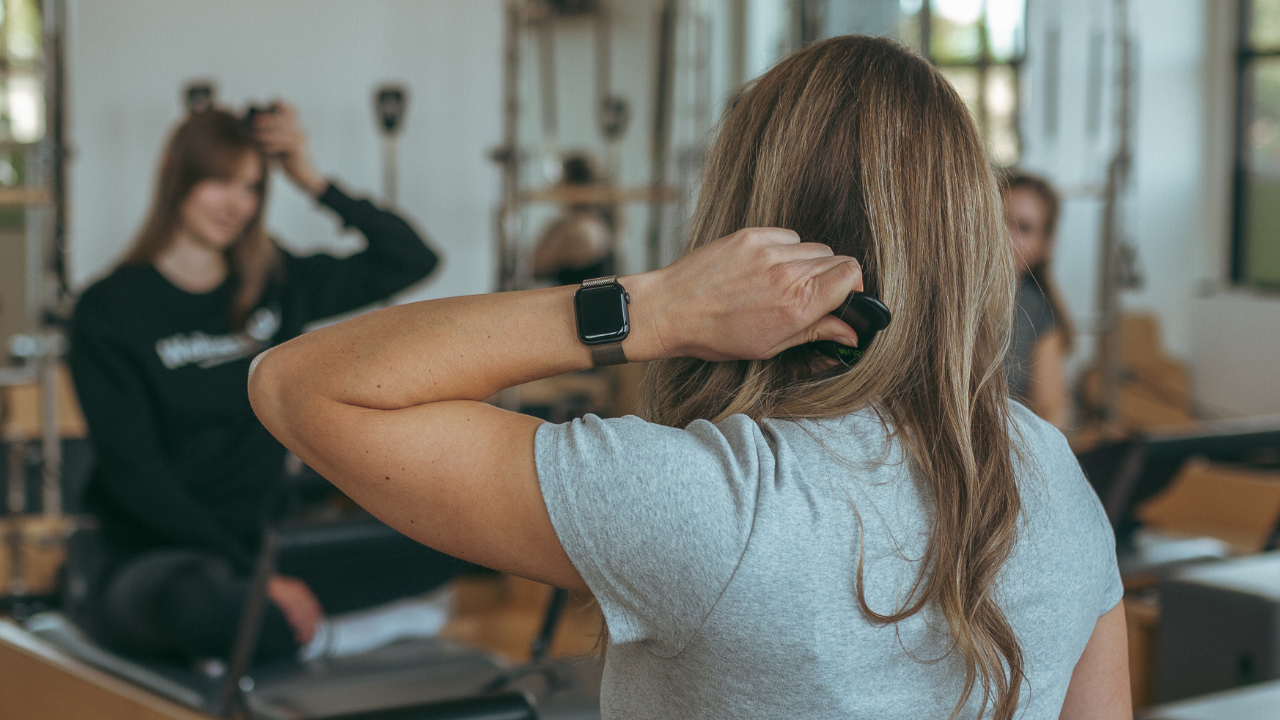
That number didn't match what we were seeing in our clinics. So we tested opening every group class with fascia work before any exercise. Over three years, across three clinics, with roughly 700 students a week and 2,000 rehab patients, we saw firing patterns shift dramatically faster — sometimes within a single session. It's not a clinical trial, but it's a consistent enough pattern across thousands of sessions that fascia work is now built into the foundation of how we train instructors.
What This Means for How You Teach
- Assessment. A client who "can't activate" a muscle may have a fascial restriction limiting the signal, not a strength problem.
- Sequencing. Fascia responds slower than muscle — it needs time, heat, and sustained pressure to shift, not a quick stretch. That's why release comes before load, not after.
- Client trust. Explaining why a release changes how an exercise feels turns it from a wellness trend into clinical insight.
Fascia isn't an extra technique to layer onto your teaching — it's the reason some cues land instantly and others never quite click. Instructors who understand it stop guessing at why a client is stuck and start knowing.
This is the foundation of every Neu Pilates course: fascia integrated from the first module, co-taught by a physiotherapist and a Pilates instructor, so the "why" is never separate from the "what."
[Explore Neu Pilates Certification]
Frequently Asked Questions
What is fascia? A continuous layer of connective tissue surrounding every muscle, organ, bone, and nerve in the body — structural and, increasingly, sensory.
Is fascia work backed by science? The field is genuinely developing. There's solid evidence fascia is richly innervated and tied to the nervous system; treat specific figures as research estimates, not settled fact.
Do I need a physiotherapy background to learn fascia release? No. Neu Pilates teaches the technique alongside the physiological reasoning, so it's never just "do this because we said so."
Resources
Jen Gulley is a physiotherapist (FCAMPT) and co-founder of Neu Pilates. Lara Yanik is a Pilates instructor and trainer with over 20 years of experience. Together they co-teach the Neu Fascia Method, integrated into every Neu Pilates certification course.
Start your journey to becoming a Pilates teacher today.
Stay connected with news and updates!
Join our mailing list to receive the latest news and updates from our team.
Don't worry, your information will not be shared.
We hate SPAM. We will never sell your information, for any reason.
