
Pilates for Chronic Low Back Pain: What Instructors Should Know
Oct 15, 2026
Pilates is one of the better-supported forms of exercise for chronic non-specific low back pain. Across several meta-analyses of randomized trials, people who did Pilates had less pain and less disability than people in control groups, and some analyses found it also outperformed other kinds of exercise, though that edge is smaller and less certain. It isn't a cure, and the research doesn't cover every kind of back. What it asks of an instructor is as much knowing your scope as knowing the exercises.
Here's what the evidence shows, where it runs out, and how we'd bring it into the room.
First, What Counts as Chronic Low Back Pain?
Chronic low back pain is pain that lasts 12 weeks or longer. The subacute phase is the stretch before that, roughly 4 to 12 weeks, when pain either settles or starts to settle in. Estimates suggest around 10 to 20 percent of people with low back pain go on to develop chronic pain.
Most of the research below studies non-specific low back pain, meaning no single structural cause has been identified. That's worth holding onto, because several of these trials excluded people with a known structural cause: fracture, infection, tumour, a herniated disc, or spinal stenosis. The findings don't automatically extend to everyone who tells you they have a "bad back."
What the Research Shows
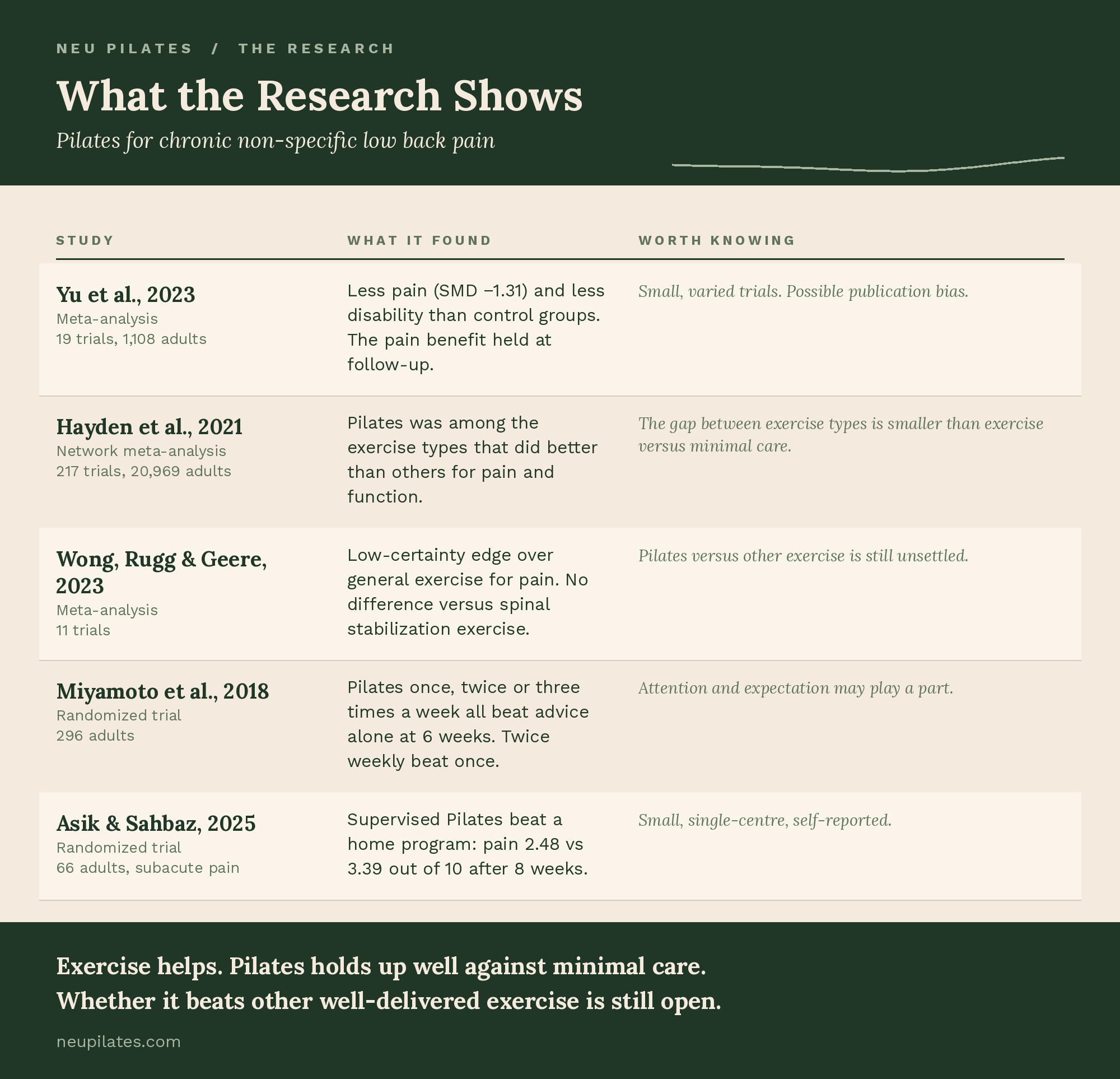
Taken together, three things hold. Exercise helps chronic low back pain, which is why guidelines recommend it as first-line care. Pilates holds up well against minimal or no treatment. And whether it beats other well-delivered exercise is still being worked out: some analyses say yes, others find no clear difference, and the certainty is low.
So the most honest thing you can tell a client is not "Pilates is the best thing for your back." It's that structured, supervised exercise helps, and Pilates is a well-studied way to do it.
How Often, and for How Long?
Dosing is still being worked out. In the Yu meta-analysis, trial programs lasted 6.8 weeks on average (range 4 to 13) at about three sessions a week (range 1 to 6), and the authors called for dose to be studied more systematically. The clearest head-to-head comes from Miyamoto's trial: twice weekly outperformed once weekly for pain and disability, and three times weekly came out as the preferred option on cost-utility. A 2025 scoping review in Sports Health maps what's known about Pilates dosing across musculoskeletal conditions more broadly.
For an instructor with a weekly group class, the practical read is that once a week is a start, and twice a week is where the trial evidence points, within what a client's pain, schedule, and life will actually allow.
Why Might It Help? (And What We Don't Know)
The explanations researchers offer are plausible but not proven. Yu and colleagues point to Pilates' emphasis on the deep stabilizing muscles (transversus abdominis, multifidus, the diaphragm, and the pelvic floor) along with postural control and breath-coordinated movement. Asik and Sahbaz suggest that supervision may improve adherence, and that combining breath, concentration, and precise movement may engage central mechanisms of pain modulation and motor learning. Miyamoto's team notes that attention and expectation may contribute too.
Probably it isn't one mechanism. A person in chronic pain is getting skilled, supervised movement, a reason to trust their body again, and a teacher who is paying attention. That last part is yours.
It's also why we look at the nervous system as well as the muscles. In our own studios we open group classes with fascia work, the connective tissue that bridges the body and the nervous system, before any loading, and we've seen movement patterns become available faster. That's clinical observation rather than trial evidence, and we're not claiming it treats back pain. We wrote more about it in What Is Fascia?.
What This Means for How You Teach
None of this makes an instructor a clinician. It does shape how you work with a client who says their back hurts.
Know where your scope ends. "Non-specific" is a conclusion a clinician reaches, not one you make. If a client has a diagnosed disc herniation, stenosis, recent spinal surgery, or nerve symptoms radiating into the leg, work alongside their physiotherapist or doctor rather than adapting a general low back plan. Much of the research above didn't include them.
Know the red flag you can't afford to miss. Back pain together with any new bladder or bowel changes (such as not knowing when the bladder is full, or leaking), numbness in the genital, buttock, or "saddle" area, or new sexual dysfunction is a reason to stop and send the client for urgent medical care the same day, not to modify the exercise. These are warning signs of cauda equina syndrome. It's rare, around 0.3 percent of people with low back pain according to a 2025 review in the British Journal of General Practice, but it's time-sensitive. Pain or weakness in both legs, or leg weakness that is getting worse, also warrants prompt medical review. This isn't a complete screening list, and a physiotherapist can help you build one for the clients you see.
Ask before you cue. How long has it been going on? Has it been assessed? What makes it better or worse? What are they afraid to do? The answers shape your first session more than any exercise list.
Track two things. The trials measure pain and function, and you can too. A 0 to 10 pain rating and a short function check, such as the Roland-Morris Questionnaire, at the start and every few weeks gives you and your client something concrete to look at instead of a feeling.
Choose language that builds confidence. Fear of moving or re-injuring is common enough in chronic back pain that researchers measure it. Plain, steady cueing, and talking about a back as something that can adapt rather than something fragile, supports a client who is already moving cautiously.
Keep it something they'll keep doing. The Hayden authors point to enjoyment as a way to support adherence. The best program for a client is often the one they'll return to.
The Takeaway
Pilates is a well-supported option for chronic non-specific low back pain, and a good instructor brings it with clear eyes: aware of what the evidence supports, honest about what it doesn't, and clear on when a client needs someone other than you. That balance of confidence without overreach is what clinical reasoning gives a teacher. It's also what we mean by physio-informed teaching.
It's the thinking behind our Rehabilitation Course: 23 modules co-taught by Jen and Lara, including injury analysis by body region (the lower back among them), pain and the stages of healing, and the red flags and physiology behind 58 base exercises. If you teach group classes, Injury-Smart Group Pilates is a continuing education course (not a certification) built around the same approach.
Explore the Neu Pilates Rehabilitation Course
Frequently Asked Questions
Does Pilates help chronic low back pain? The evidence suggests it does, for non-specific chronic low back pain. A 2023 meta-analysis of 19 randomized trials (1,108 adults) found less pain and disability with Pilates than in control groups, and a 2021 network meta-analysis of 217 trials placed Pilates among the more effective exercise types. It isn't a cure, and results vary from person to person.
Is Pilates better than other exercise for low back pain? It's mixed. Some analyses found Pilates more effective than other exercise types, while a 2023 meta-analysis found low-certainty evidence that it beat general exercise and no difference versus spinal stabilization exercise for pain. Both agree that exercise of nearly any type beats minimal treatment.
How often should someone with chronic low back pain do Pilates? There's no single established dose. In one trial, twice a week produced better pain and disability results than once a week, and three times a week was the preferred option on cost-utility. Most trial programs ran for several weeks at around three sessions a week. Anyone with a diagnosis should be guided by their clinician.
Is Pilates safe for people with low back pain? Safety is under-reported. In the 2023 meta-analysis, only one of 19 trials reported on adverse events, so the authors couldn't make a safety determination. A separate 2023 review concluded that Pilates appears safe for most people with low back pain. In practice, that means screening first, working within a client's diagnosis, and sending anyone with red flag symptoms for medical assessment before they exercise.
Can a Pilates instructor treat low back pain? No. Instructors teach and modify movement; diagnosis and treatment sit with physiotherapists and doctors. What a well-trained instructor can do is teach safely around a known condition, recognize when something is outside their scope, and refer.
What should I do if a client mentions numbness or bladder changes with back pain? Stop the session and direct them to urgent medical care the same day. New bladder or bowel changes, numbness in the saddle area, or new sexual dysfunction alongside back pain can signal cauda equina syndrome, which needs prompt assessment.
Sources
- Yu Z, et al. Efficacy of Pilates on Pain, Functional Disorders and Quality of Life in Patients with Chronic Low Back Pain: A Systematic Review and Meta-Analysis. Int J Environ Res Public Health. 2023;20(4):2850. PMC
- Hayden JA, et al. Some types of exercise are more effective than others in people with chronic low back pain: a network meta-analysis. J Physiother. 2021;67(4):252-262. DOI
- Wong CM, Rugg B, Geere JA. The effects of Pilates exercise in comparison to other forms of exercise on pain and disability in individuals with chronic non-specific low back pain: a systematic review with meta-analysis. Musculoskeletal Care. 2023;21(1):78-96. UEA repository
- Miyamoto GC, et al. Different doses of Pilates-based exercise therapy for chronic low back pain: a randomised controlled trial with economic evaluation. Br J Sports Med. 2018;52(13):859-868. BJSM
- Asik HK, Sahbaz T. Preventing chronic low back pain: investigating the role of Pilates in subacute management, a randomized controlled trial. Ir J Med Sci. 2025;194(3):949-956. PMC
- Sivrika AP, et al. Pilates dosage in rehabilitation of patients with musculoskeletal conditions: a scoping review. Sports Health. 2025;17(4):824-833. PMC
- Effectiveness of Pilates exercise on low back pain: a systematic review with meta-analysis. Disabil Rehabil. 2023. DOI
- Cauda equina syndrome: Br J Gen Pract, 2025;75(757) · NHS Ayrshire & Arran referral guidance
Jen Gulley is a physiotherapist (FCAMPT) and co-founder of Neu Pilates. Lara Yanik is a Pilates instructor and trainer with over 20 years of experience. Together they co-teach every Neu Pilates course. This article is educational and is not medical advice.
Start your journey to becoming a Pilates teacher today.
Stay connected with news and updates!
Join our mailing list to receive the latest news and updates from our team.
Don't worry, your information will not be shared.
We hate SPAM. We will never sell your information, for any reason.
